
Run QMRA on addition process
run_qmra_supplementary_process.RdRun the full QMRA workflow on additional processes
simulate inflow concentration, volume of exposure
calculate initial dose
simulate log reduction for barrier processes
calculate final dose
calculate infection probability, illness probability and dalys reduction
calculate annual total risk
Arguments
- scenario
data.frame scenario obtained with create_scenario function
- pathogen
character Name of the pathogen to simulate
- regulationLog
data.frame regulation value of the log reduction to compare with simulation result
- regulationConcentration
data.frame regulation value of the log reduction to compare with simulation result
Examples
# \donttest{
library(dplyr)
scenario <- create_scenario(system.file("input_1culture_2pop.xlsx", package = "ambre"))
regulation_reduction <- config_ambre$regulation$regulation_value |>
dplyr::filter(Country == "France") |>
dplyr::select(-c(Concentration, Country, RegulationID))
regulation_concentration <- config_ambre$regulation$regulation_value |>
dplyr::filter(Country == "France") |>
dplyr::select(-c(Country, RegulationID, Reduction))
run_qmra_supplementary_process(scenario = scenario,
pathogen = c("Campylobacter jejuni", "Escherichia coli"),
regulationLog = regulation_reduction,
regulationConcentration = regulation_concentration)
#> Simulated pathogen: Campylobacter jejuni
#> Create 1000 random distribution(s): uniform (n: 60, min: 100.000000, max: 5000.000000)
#> Simulated pathogen: Escherichia coli
#> Create 1000 random distribution(s): uniform (n: 60, min: 10000000.000000, max: 1000000000.000000)
#> Providing inflow events ... ok. (0.01 secs)
#> Providing inflow paras ... ok. (0.00 secs)
#> Simulated pathogen: Campylobacter jejuni
#> Create 1000 random distribution(s): uniform (n: 48, min: 100.000000, max: 5000.000000)
#> Simulated pathogen: Escherichia coli
#> Create 1000 random distribution(s): uniform (n: 48, min: 10000000.000000, max: 1000000000.000000)
#> Providing inflow events ... ok. (0.01 secs)
#> Providing inflow paras ... ok. (0.00 secs)
#> Simulated exposure: volume per event
#> Distribution set from 'triangle' to 'uniform' because 'min' equals 'max'
#> Create 1000 random distribution(s): uniform (n: 60, min: 0.001000, max: 0.001000)
#> Simulated exposure: volume per event
#> Distribution set from 'triangle' to 'uniform' because 'min' equals 'max'
#> Create 1000 random distribution(s): uniform (n: 48, min: 0.001000, max: 0.001000)
#> Create 1000 random distribution(s): uniform (n: 60, min: 1.000000, max: 2.000000)
#> Create 1000 random distribution(s): uniform (n: 60, min: 1.000000, max: 3.000000)
#> Create 1000 random distribution(s): uniform (n: 60, min: 5.000000, max: 7.000000)
#> Create 1000 random distribution(s): uniform (n: 60, min: 1.000000, max: 1.000000)
#> Simulated treatment: Q.1 - Activated Sludge for Bacteria
#> Simulated treatment: Q.2 - Maturation Pond for Bacteria
#> Simulated treatment: Q.6 - Chlorination for Bacteria
#> Simulated treatment: E.1.1 - Micro-sprinkler for Bacteria
#> Simulated treatment: Q.1 - Activated Sludge for Bacteria
#> Simulated treatment: Q.2 - Maturation Pond for Bacteria
#> Simulated treatment: Q.6 - Chlorination for Bacteria
#> Simulated treatment: E.1.1 - Micro-sprinkler for Bacteria
#> Joining with `by = join_by(TreatmentID)`
#> Joining with `by = join_by(TreatmentID)`
#> Create 1000 random distribution(s): uniform (n: 48, min: 1.000000, max: 2.000000)
#> Create 1000 random distribution(s): uniform (n: 48, min: 1.000000, max: 3.000000)
#> Create 1000 random distribution(s): uniform (n: 48, min: 5.000000, max: 7.000000)
#> Create 1000 random distribution(s): uniform (n: 48, min: 3.000000, max: 6.000000)
#> Simulated treatment: Q.1 - Activated Sludge for Bacteria
#> Simulated treatment: Q.2 - Maturation Pond for Bacteria
#> Simulated treatment: Q.6 - Chlorination for Bacteria
#> Simulated treatment: P.5 - Natural die-off for Bacteria
#> Simulated treatment: Q.1 - Activated Sludge for Bacteria
#> Simulated treatment: Q.2 - Maturation Pond for Bacteria
#> Simulated treatment: Q.6 - Chlorination for Bacteria
#> Simulated treatment: P.5 - Natural die-off for Bacteria
#> Joining with `by = join_by(TreatmentID)`
#> Joining with `by = join_by(TreatmentID)`
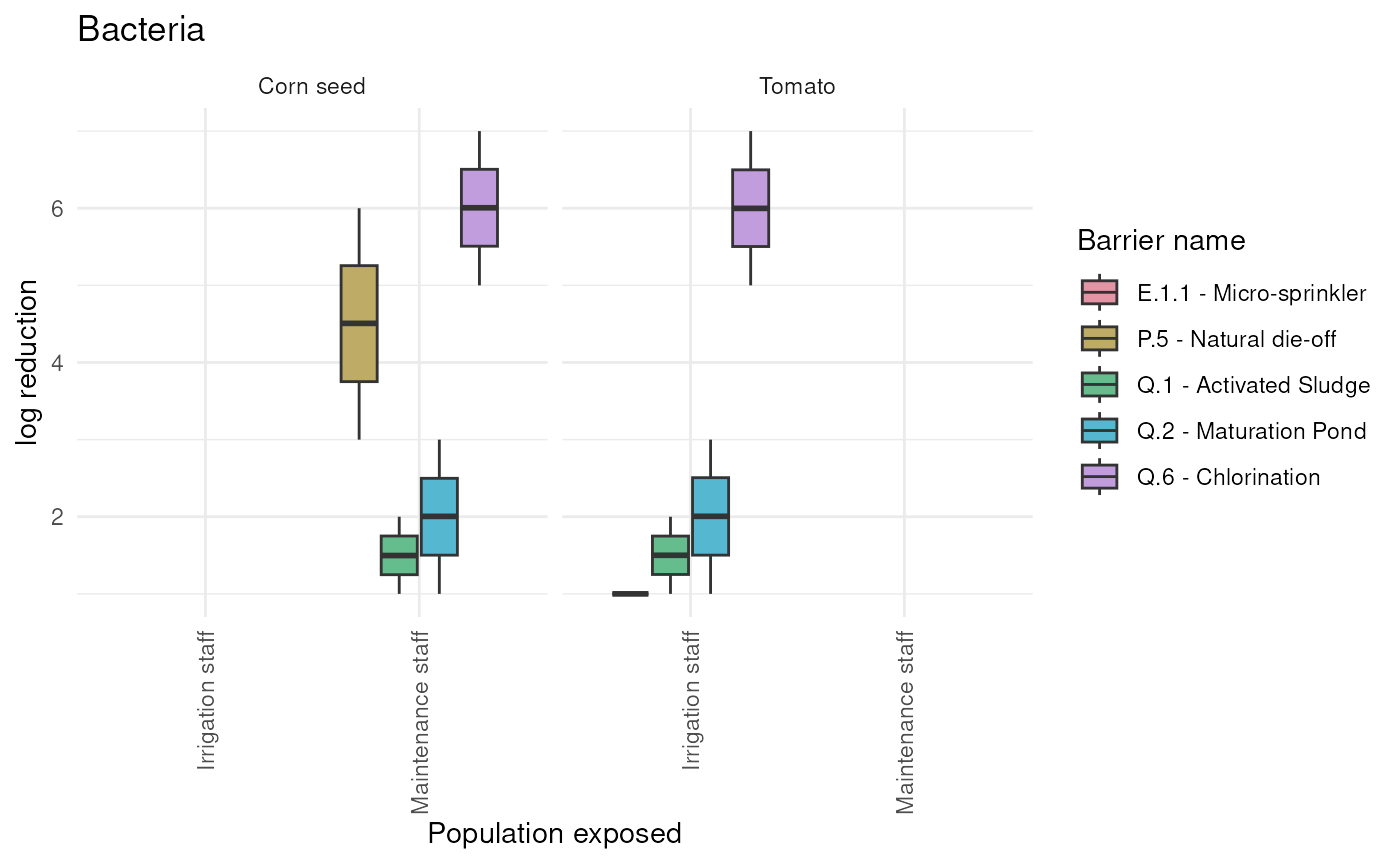
#> $logreduction
#> $logreduction$Bacteria
 #>
#>
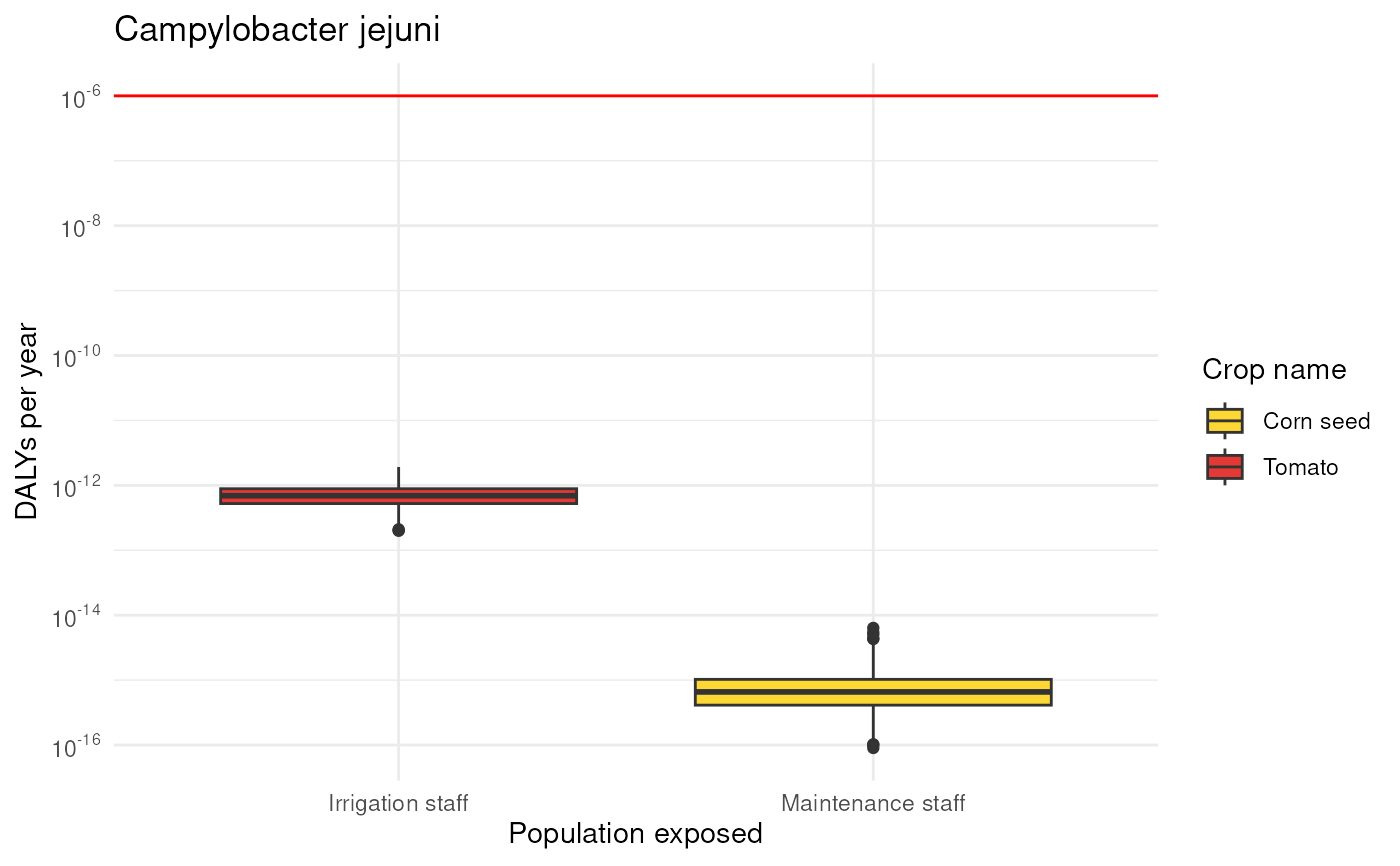
#> $dalys
#> $dalys$`Campylobacter jejuni`
#>
#>
#> $dalys
#> $dalys$`Campylobacter jejuni`
 #>
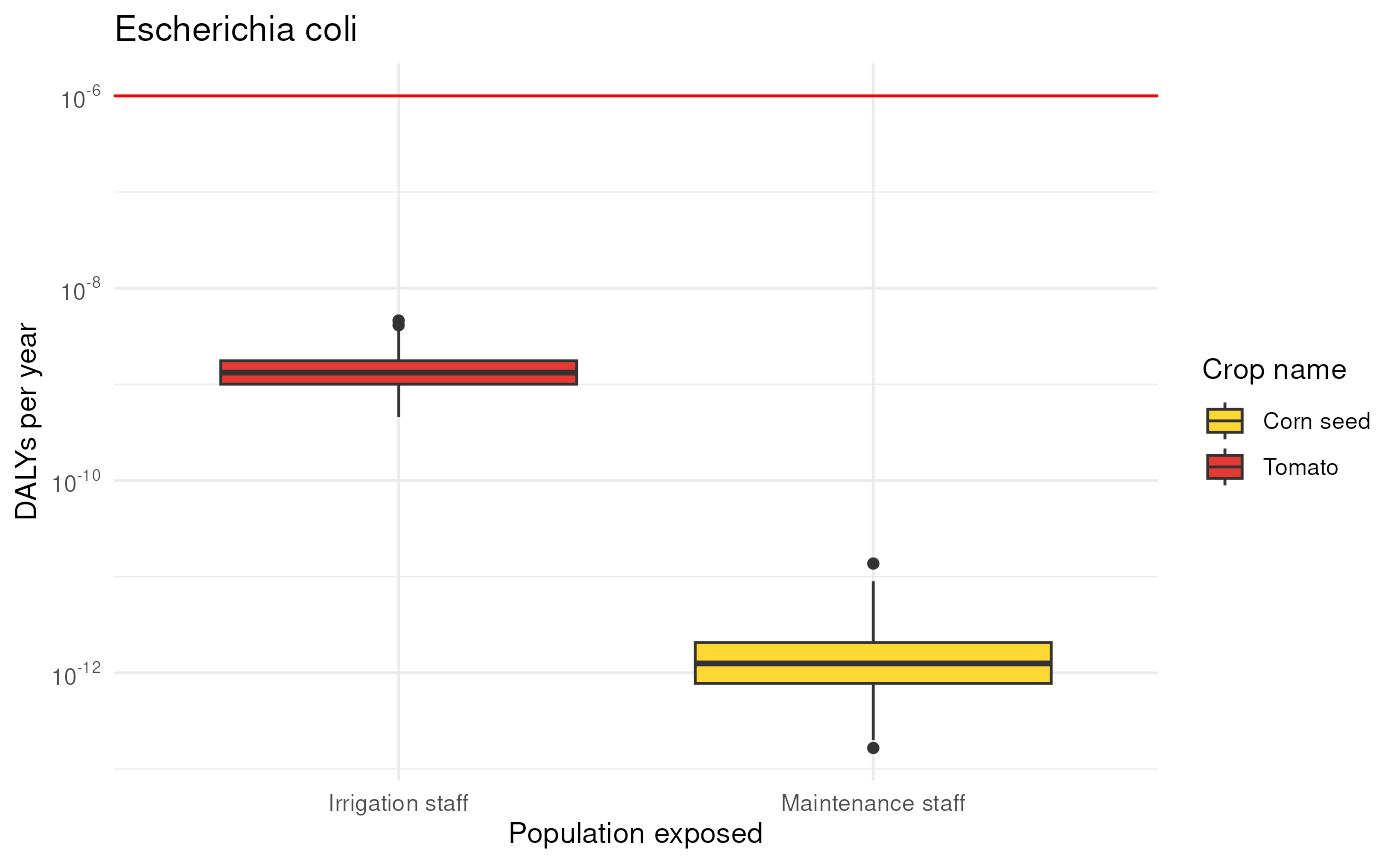
#> $dalys$`Escherichia coli`
#>
#> $dalys$`Escherichia coli`
 #>
#>
#> $regul_matrix_log
#>
#> $regul_matrix_concentration
#>
# }
#>
#>
#> $regul_matrix_log
#>
#> $regul_matrix_concentration
#>
# }