
Run QMRA custom
run_qmra_custom.RdRun the full QMRA workflow using custom data for volume and frequency of exposure (not the default databases)
simulate inflow concentration, volume of exposure
calculate initial dose
simulate log reduction for treatment processes
calculate final dose
calculate infection probability, illness probability and dalys reduction
calculate annual total risk
Usage
run_qmra_custom(
  scenario,
  volume,
  frequency,
  concentration,
  objective = 1e-06,
  regulationLog,
  regulationConcentration,
  initialSituation
)
Arguments
- scenario
data.frame obtain with create_scenario function
- volume
data.frame of min and max value, same size as scenario
- frequency
array of integer same size as scenario
- concentration
data.frame of pathogenName, min, max and distribution law to simulate
- objective
numeric reference dalys threshold to compare simulation result on dalys plot. default value is OMS threshold 1e-6 dalys
- regulationLog
data.frame regulation value of the log reduction to compare with simulation result
- regulationConcentration
data.frame regulation value of the log reduction to compare with simulation result
- initialSituation
boolean, TRUE to consider InitialTrainID for simulation, FALSE to consider SupplementaryTrainID for simulation
Examples
# \donttest{
sc <- create_scenario(system.file("input_1culture_2pop.xlsx", package = "ambre"))
regulation_reduction <- config_ambre$regulation$regulation_value |>
dplyr::filter(Country == "France") |>
dplyr::select(-c(Concentration, Country, RegulationID))
regulation_concentration <- config_ambre$regulation$regulation_value |>
dplyr::filter(Country == "France") |>
dplyr::select(-c(Country, RegulationID, Reduction))
concentration_custom <- data.frame(PathogenName = c("Rotavirus"),
min = c(1),
max = c(2),
type = c("uniform"))
run_qmra_custom(scenario = sc,
concentration = concentration_custom,
volume = data.frame(min=c(0.5,1), max = c(1,2), type= c("triangle", "triangle")),
frequency = c(200L, 300L),
regulationLog = regulation_reduction,
regulationConcentration = regulation_concentration,
initialSituation = TRUE)
#> Simulated pathogen: Rotavirus
#> Create 1000 random distribution(s): uniform (n: 200, min: 1.000000, max: 2.000000)
#> Providing inflow events ... ok. (0.01 secs)
#> Providing inflow paras ... ok. (0.00 secs)
#> Simulated pathogen: Rotavirus
#> Create 1000 random distribution(s): uniform (n: 300, min: 1.000000, max: 2.000000)
#> Providing inflow events ... ok. (0.02 secs)
#> Providing inflow paras ... ok. (0.00 secs)
#> Simulated exposure: volume per event
#> Create 1000 random distribution(s): triangle (n: 200, min: 0.500000, max: 1.000000, mode = 0.750000)
#> Simulated exposure: volume per event
#> Create 1000 random distribution(s): triangle (n: 300, min: 1.000000, max: 2.000000, mode = 1.500000)
#> Create 1000 random distribution(s): uniform (n: 200, min: 1.000000, max: 2.000000)
#> Create 1000 random distribution(s): uniform (n: 200, min: 1.000000, max: 2.000000)
#> Create 1000 random distribution(s): uniform (n: 200, min: 2.000000, max: 4.000000)
#> Simulated treatment: Q.1 - Activated Sludge for Viruses
#> Simulated treatment: Q.2 - Maturation Pond for Viruses
#> Simulated treatment: Q.6 - Chlorination for Viruses
#> Simulated treatment: Q.1 - Activated Sludge for Viruses
#> Simulated treatment: Q.2 - Maturation Pond for Viruses
#> Simulated treatment: Q.6 - Chlorination for Viruses
#> Joining with `by = join_by(TreatmentID)`
#> Joining with `by = join_by(TreatmentID)`
#> Create 1000 random distribution(s): uniform (n: 300, min: 1.000000, max: 2.000000)
#> Create 1000 random distribution(s): uniform (n: 300, min: 1.000000, max: 2.000000)
#> Create 1000 random distribution(s): uniform (n: 300, min: 2.000000, max: 4.000000)
#> Simulated treatment: Q.1 - Activated Sludge for Viruses
#> Simulated treatment: Q.2 - Maturation Pond for Viruses
#> Simulated treatment: Q.6 - Chlorination for Viruses
#> Simulated treatment: Q.1 - Activated Sludge for Viruses
#> Simulated treatment: Q.2 - Maturation Pond for Viruses
#> Simulated treatment: Q.6 - Chlorination for Viruses
#> Joining with `by = join_by(TreatmentID)`
#> Joining with `by = join_by(TreatmentID)`
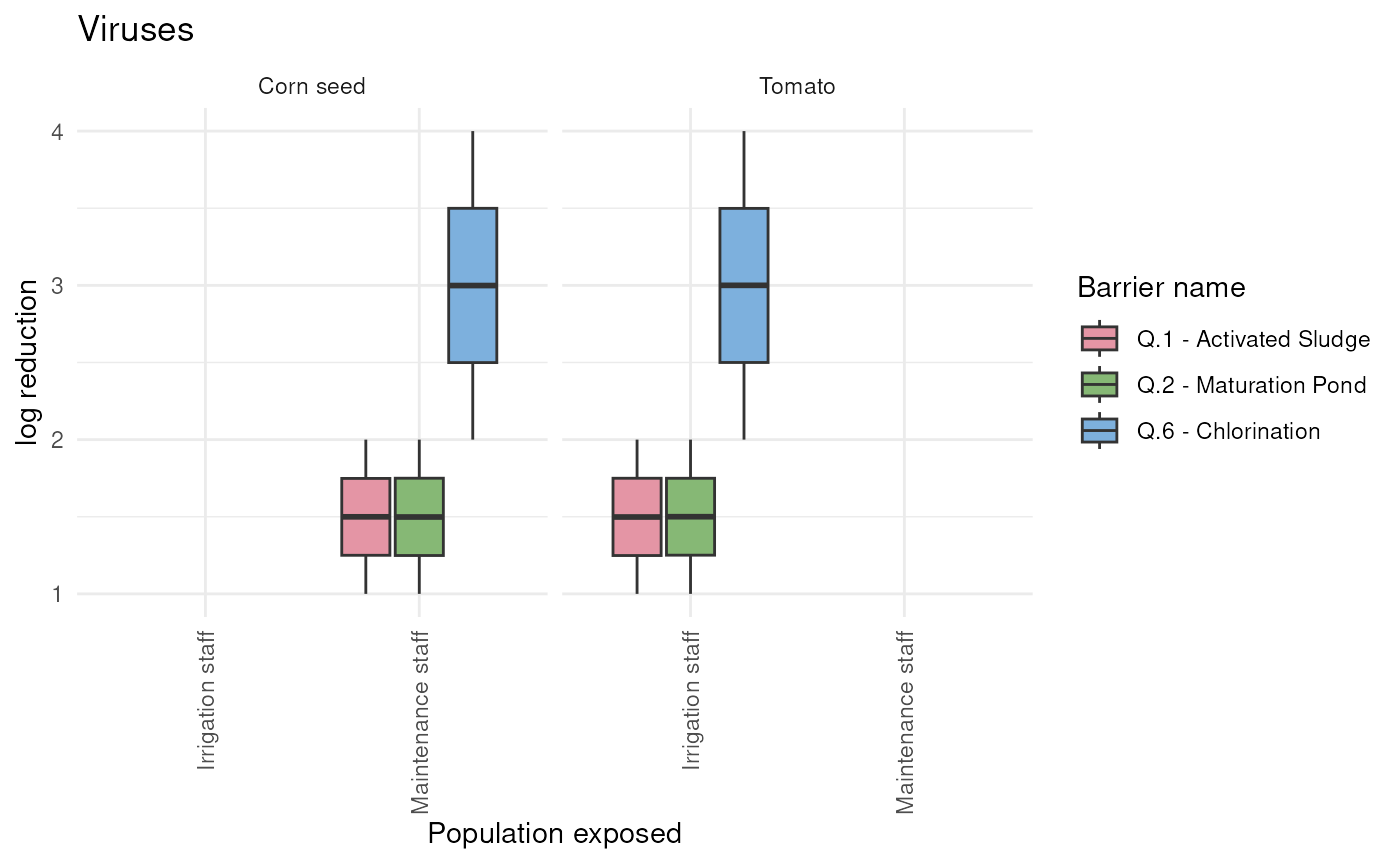
#> $logreduction
#> $logreduction$Viruses
 #>
#>
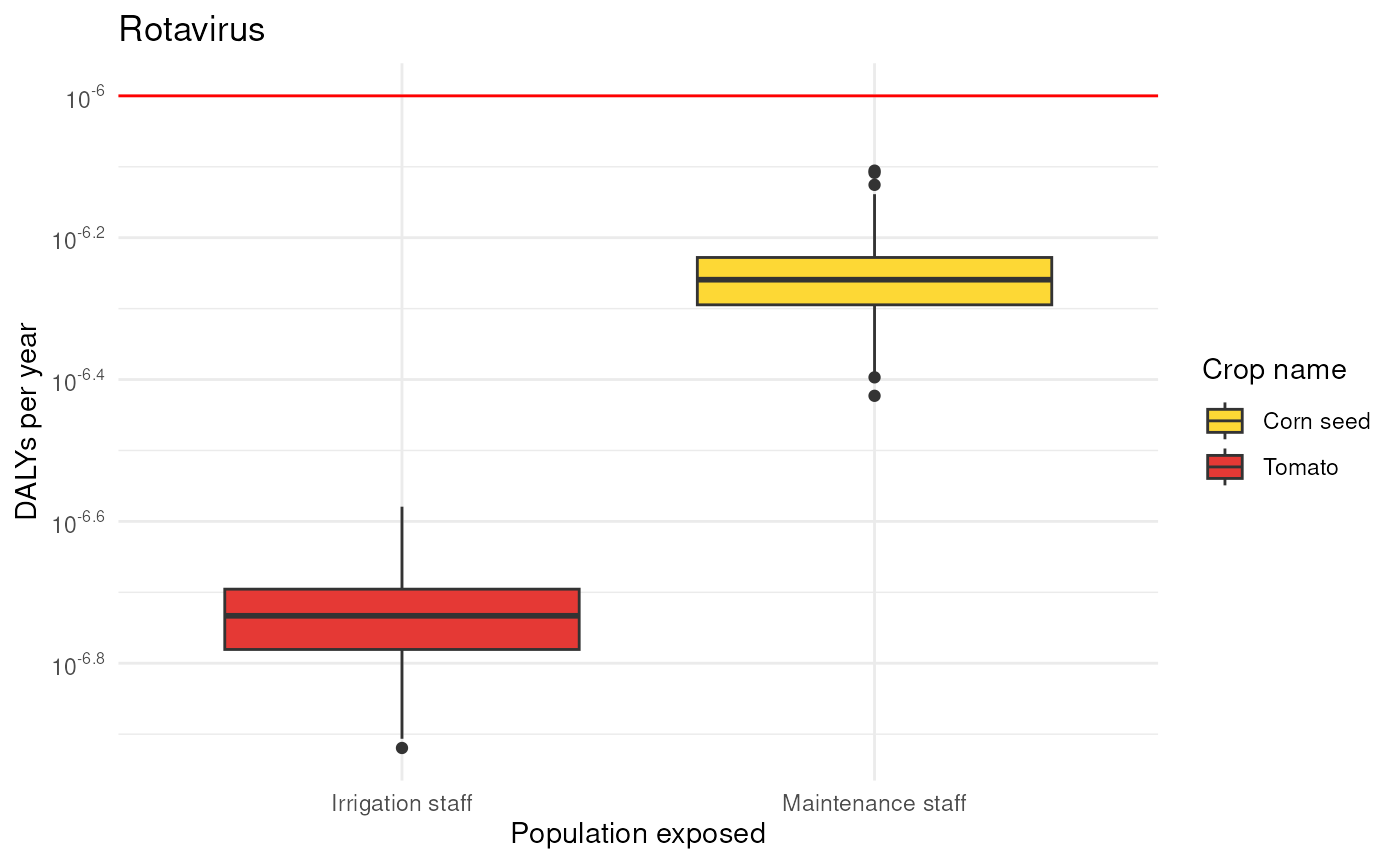
#> $dalys
#> $dalys$Rotavirus
#>
#>
#> $dalys
#> $dalys$Rotavirus
 #>
#>
#> $regul_matrix_log
#>
#> $regul_matrix_concentration
#>
run_qmra_custom(scenario = sc,
concentration = concentration_custom,
volume = data.frame(min=c(0.5,1), max = c(1,2), type= c("triangle", "triangle")),
frequency = c(200L, 300L),
regulationLog = regulation_reduction,
regulationConcentration = regulation_concentration,
initialSituation = FALSE)
#> Simulated pathogen: Rotavirus
#> Create 1000 random distribution(s): uniform (n: 200, min: 1.000000, max: 2.000000)
#> Providing inflow events ... ok. (0.01 secs)
#> Providing inflow paras ... ok. (0.00 secs)
#> Simulated pathogen: Rotavirus
#> Create 1000 random distribution(s): uniform (n: 300, min: 1.000000, max: 2.000000)
#> Providing inflow events ... ok. (0.02 secs)
#> Providing inflow paras ... ok. (0.00 secs)
#> Simulated exposure: volume per event
#> Create 1000 random distribution(s): triangle (n: 200, min: 0.500000, max: 1.000000, mode = 0.750000)
#> Simulated exposure: volume per event
#> Create 1000 random distribution(s): triangle (n: 300, min: 1.000000, max: 2.000000, mode = 1.500000)
#> Create 1000 random distribution(s): uniform (n: 200, min: 1.000000, max: 2.000000)
#> Create 1000 random distribution(s): uniform (n: 200, min: 1.000000, max: 2.000000)
#> Create 1000 random distribution(s): uniform (n: 200, min: 2.000000, max: 4.000000)
#> Create 1000 random distribution(s): uniform (n: 200, min: 1.000000, max: 1.000000)
#> Simulated treatment: Q.1 - Activated Sludge for Viruses
#> Simulated treatment: Q.2 - Maturation Pond for Viruses
#> Simulated treatment: Q.6 - Chlorination for Viruses
#> Simulated treatment: E.1.1 - Micro-sprinkler for Viruses
#> Simulated treatment: Q.1 - Activated Sludge for Viruses
#> Simulated treatment: Q.2 - Maturation Pond for Viruses
#> Simulated treatment: Q.6 - Chlorination for Viruses
#> Simulated treatment: E.1.1 - Micro-sprinkler for Viruses
#> Joining with `by = join_by(TreatmentID)`
#> Joining with `by = join_by(TreatmentID)`
#> Create 1000 random distribution(s): uniform (n: 300, min: 1.000000, max: 2.000000)
#> Create 1000 random distribution(s): uniform (n: 300, min: 1.000000, max: 2.000000)
#> Create 1000 random distribution(s): uniform (n: 300, min: 2.000000, max: 4.000000)
#> Create 1000 random distribution(s): uniform (n: 300, min: 1.500000, max: 3.000000)
#> Simulated treatment: Q.1 - Activated Sludge for Viruses
#> Simulated treatment: Q.2 - Maturation Pond for Viruses
#> Simulated treatment: Q.6 - Chlorination for Viruses
#> Simulated treatment: P.5 - Natural die-off for Viruses
#> Simulated treatment: Q.1 - Activated Sludge for Viruses
#> Simulated treatment: Q.2 - Maturation Pond for Viruses
#> Simulated treatment: Q.6 - Chlorination for Viruses
#> Simulated treatment: P.5 - Natural die-off for Viruses
#> Joining with `by = join_by(TreatmentID)`
#> Joining with `by = join_by(TreatmentID)`
#> $logreduction
#> $logreduction$Viruses
#>
#>
#> $regul_matrix_log
#>
#> $regul_matrix_concentration
#>
run_qmra_custom(scenario = sc,
concentration = concentration_custom,
volume = data.frame(min=c(0.5,1), max = c(1,2), type= c("triangle", "triangle")),
frequency = c(200L, 300L),
regulationLog = regulation_reduction,
regulationConcentration = regulation_concentration,
initialSituation = FALSE)
#> Simulated pathogen: Rotavirus
#> Create 1000 random distribution(s): uniform (n: 200, min: 1.000000, max: 2.000000)
#> Providing inflow events ... ok. (0.01 secs)
#> Providing inflow paras ... ok. (0.00 secs)
#> Simulated pathogen: Rotavirus
#> Create 1000 random distribution(s): uniform (n: 300, min: 1.000000, max: 2.000000)
#> Providing inflow events ... ok. (0.02 secs)
#> Providing inflow paras ... ok. (0.00 secs)
#> Simulated exposure: volume per event
#> Create 1000 random distribution(s): triangle (n: 200, min: 0.500000, max: 1.000000, mode = 0.750000)
#> Simulated exposure: volume per event
#> Create 1000 random distribution(s): triangle (n: 300, min: 1.000000, max: 2.000000, mode = 1.500000)
#> Create 1000 random distribution(s): uniform (n: 200, min: 1.000000, max: 2.000000)
#> Create 1000 random distribution(s): uniform (n: 200, min: 1.000000, max: 2.000000)
#> Create 1000 random distribution(s): uniform (n: 200, min: 2.000000, max: 4.000000)
#> Create 1000 random distribution(s): uniform (n: 200, min: 1.000000, max: 1.000000)
#> Simulated treatment: Q.1 - Activated Sludge for Viruses
#> Simulated treatment: Q.2 - Maturation Pond for Viruses
#> Simulated treatment: Q.6 - Chlorination for Viruses
#> Simulated treatment: E.1.1 - Micro-sprinkler for Viruses
#> Simulated treatment: Q.1 - Activated Sludge for Viruses
#> Simulated treatment: Q.2 - Maturation Pond for Viruses
#> Simulated treatment: Q.6 - Chlorination for Viruses
#> Simulated treatment: E.1.1 - Micro-sprinkler for Viruses
#> Joining with `by = join_by(TreatmentID)`
#> Joining with `by = join_by(TreatmentID)`
#> Create 1000 random distribution(s): uniform (n: 300, min: 1.000000, max: 2.000000)
#> Create 1000 random distribution(s): uniform (n: 300, min: 1.000000, max: 2.000000)
#> Create 1000 random distribution(s): uniform (n: 300, min: 2.000000, max: 4.000000)
#> Create 1000 random distribution(s): uniform (n: 300, min: 1.500000, max: 3.000000)
#> Simulated treatment: Q.1 - Activated Sludge for Viruses
#> Simulated treatment: Q.2 - Maturation Pond for Viruses
#> Simulated treatment: Q.6 - Chlorination for Viruses
#> Simulated treatment: P.5 - Natural die-off for Viruses
#> Simulated treatment: Q.1 - Activated Sludge for Viruses
#> Simulated treatment: Q.2 - Maturation Pond for Viruses
#> Simulated treatment: Q.6 - Chlorination for Viruses
#> Simulated treatment: P.5 - Natural die-off for Viruses
#> Joining with `by = join_by(TreatmentID)`
#> Joining with `by = join_by(TreatmentID)`
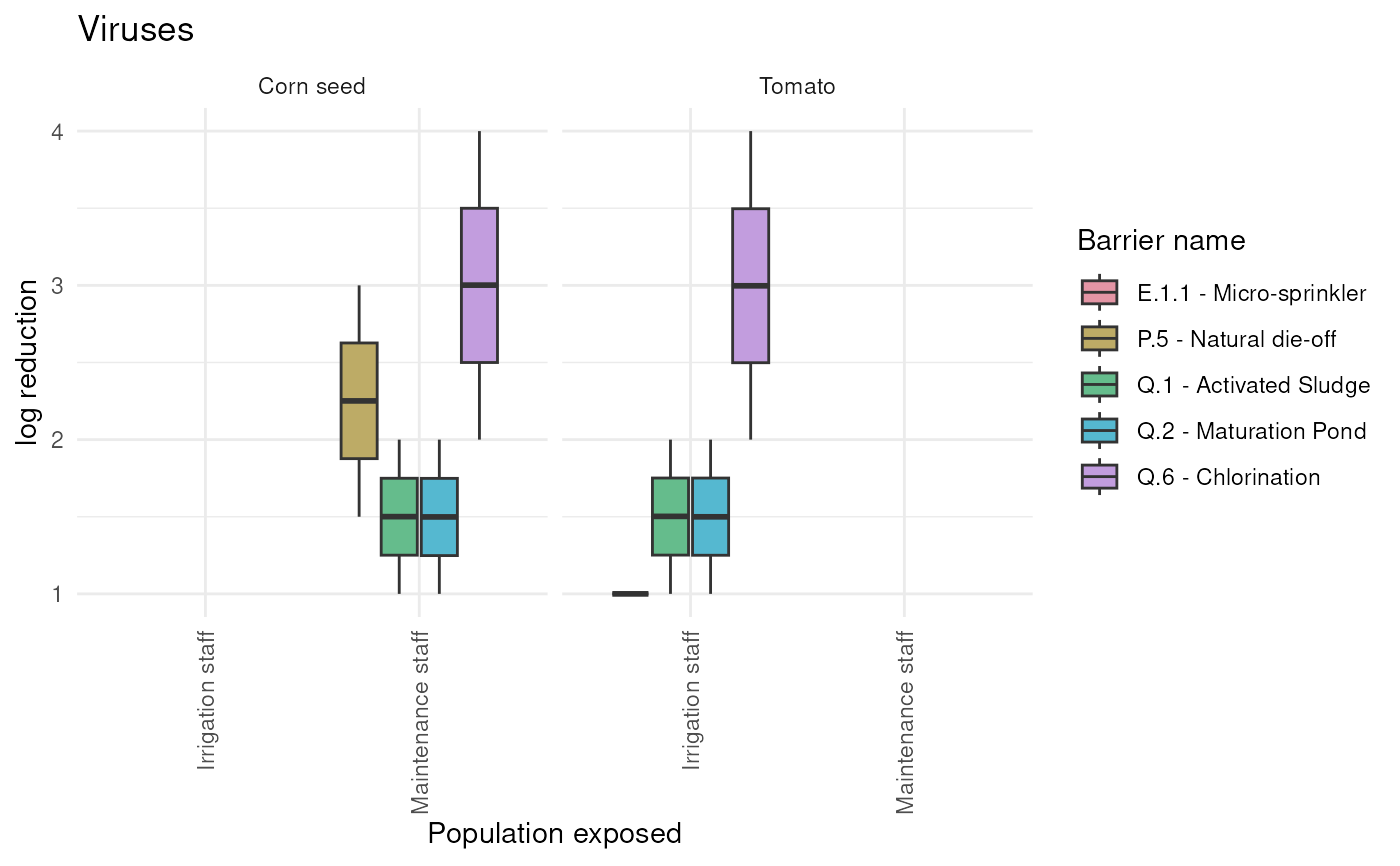
#> $logreduction
#> $logreduction$Viruses
 #>
#>
#> $dalys
#> $dalys$Rotavirus
#>
#>
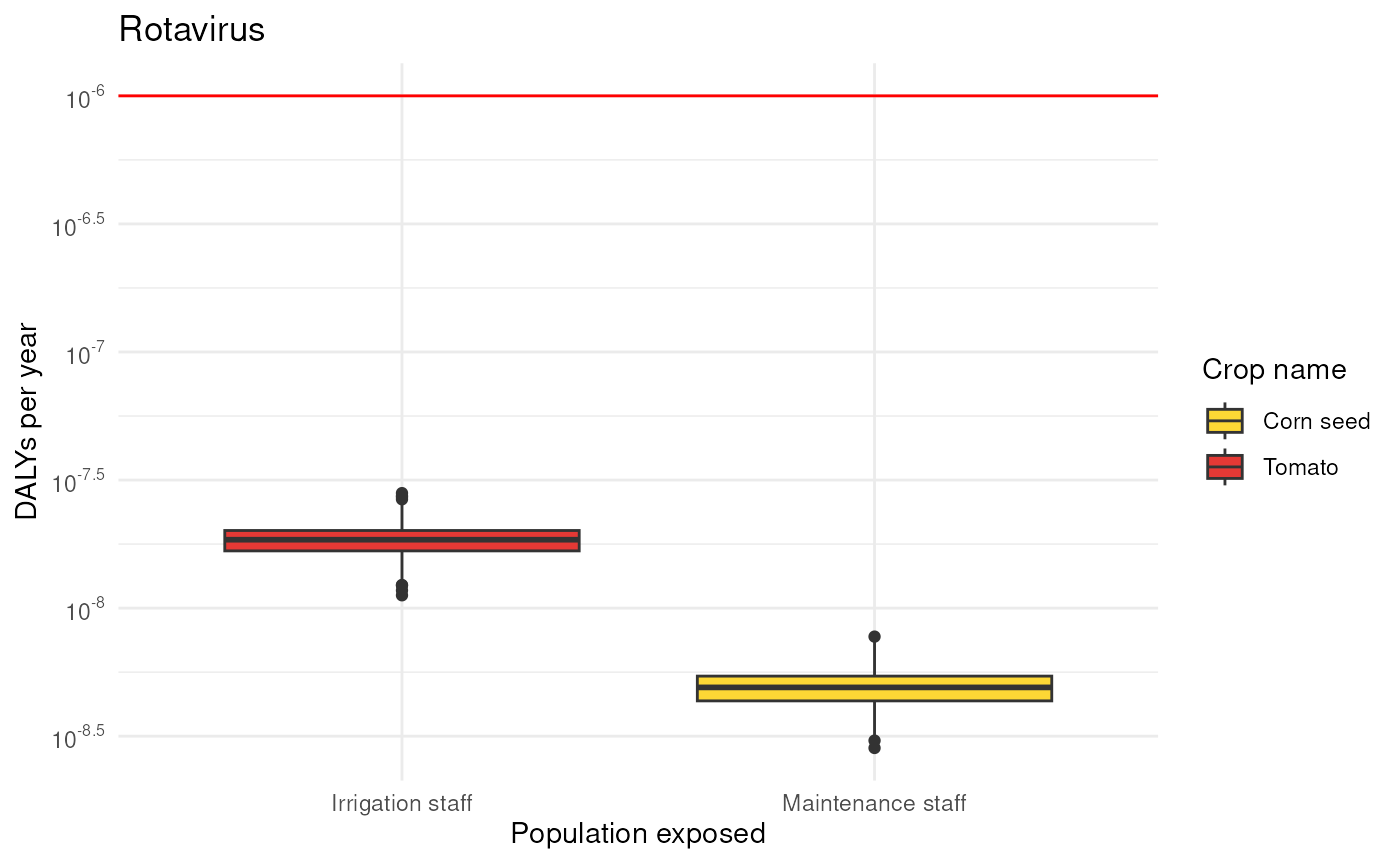
#> $dalys
#> $dalys$Rotavirus
 #>
#>
#> $regul_matrix_log
#>
#> $regul_matrix_concentration
#>
# }
#>
#>
#> $regul_matrix_log
#>
#> $regul_matrix_concentration
#>
# }